


Over the course of the last several years, large U.S. companies have dominated the headlines. Looking back 10 years, the S&P 500 is up close to 240%. Over the last 5 years, it is up over 70%. Recently, however, other asset classes are starting to outperform. Looking at the data, there are ways to position any investment portfolio to benefit in the long term.
Diversification and patience can pay off over time, given the right market environment. Having exposure to other market sectors provides a visible benefit as markets change and new leaders emerge.
Last year, International stocks and Emerging Markets picked up steam after underperforming domestic equities for years. This was due, in part, to the global economy growing at a faster rate than the U.S. economy as well as the weakening of the dollar (which fell by over 9% against major currencies early in the year). Another reason International and Emerging Markets performed so well last year was that their valuation was more attractive compared with U.S. investment options. This was due in large part to the U.S. market having performed so well for so long as well as factors noted above.
There has been a bit of fluctuation this year due to market reactions to events in Iran. The dollar initially strengthened as it acted as a safe haven amidst U.S.-Iran tensions, but it has weakened as tensions have eased in recent weeks. Despite these fluctuations in the dollar (which have historically happened for various reasons and are generally considered a normal occurrence), expectations are that the International and Emerging Markets sectors will continue to perform well over the course of the year.
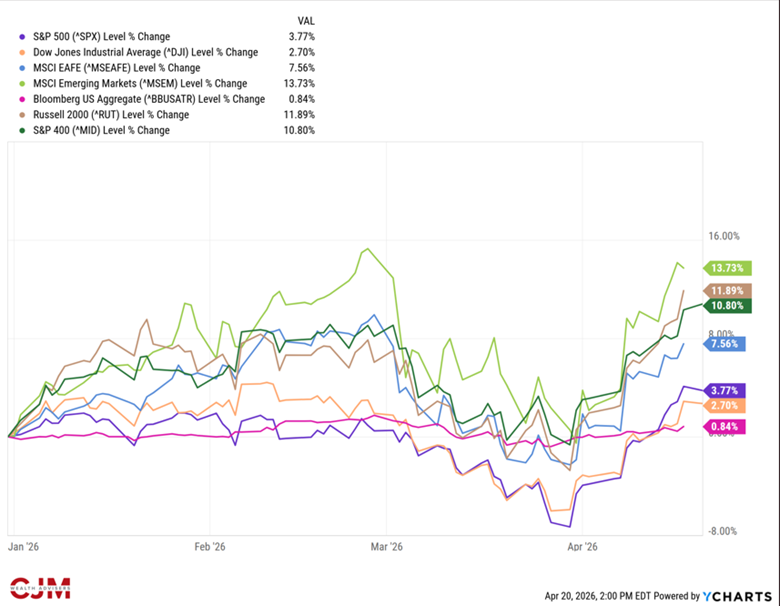
Worries over AI spending in early 2026 have put pressure on the Dow Jones and the Nasdaq, contributing to a sell-off and resulting in market participants looking for other places to invest their money. Other U.S. sectors have benefitted in the wake of this concern. Mid-sized U.S. companies have performed well this year, with the S&P 400 returning over 10% year-to-date through mid-April. Robust earnings growth and attractive valuations relative to larger U.S. technology companies are among factors that have been helpful to mid-sized U.S. companies this year have been.
Small U.S. companies, also benefitting from strong earnings reports, are not far behind, with the Russell 2000 close to a 12% gain on the year. In a portfolio containing only exposure to large U.S. companies (which are returning, in aggregate, somewhere in the range of 3-4% so far this year), the benefit that could have been provided from exposure to some of these other areas is a missed opportunity. The chart below illustrates how markets have fared so far this year:
Finally, a critical point to emphasize is that the benefits of maintaining a well-diversified portfolio are realized over the long term. As sectors fall in and out of favor, history has shown that this behavior is often cyclical. There is a real benefit to maintaining a disciplined portfolio rebalancing plan over time in order to add to sectors while they are lower and trim sectors while they are higher, and the proof is in performance over time.
Social Media